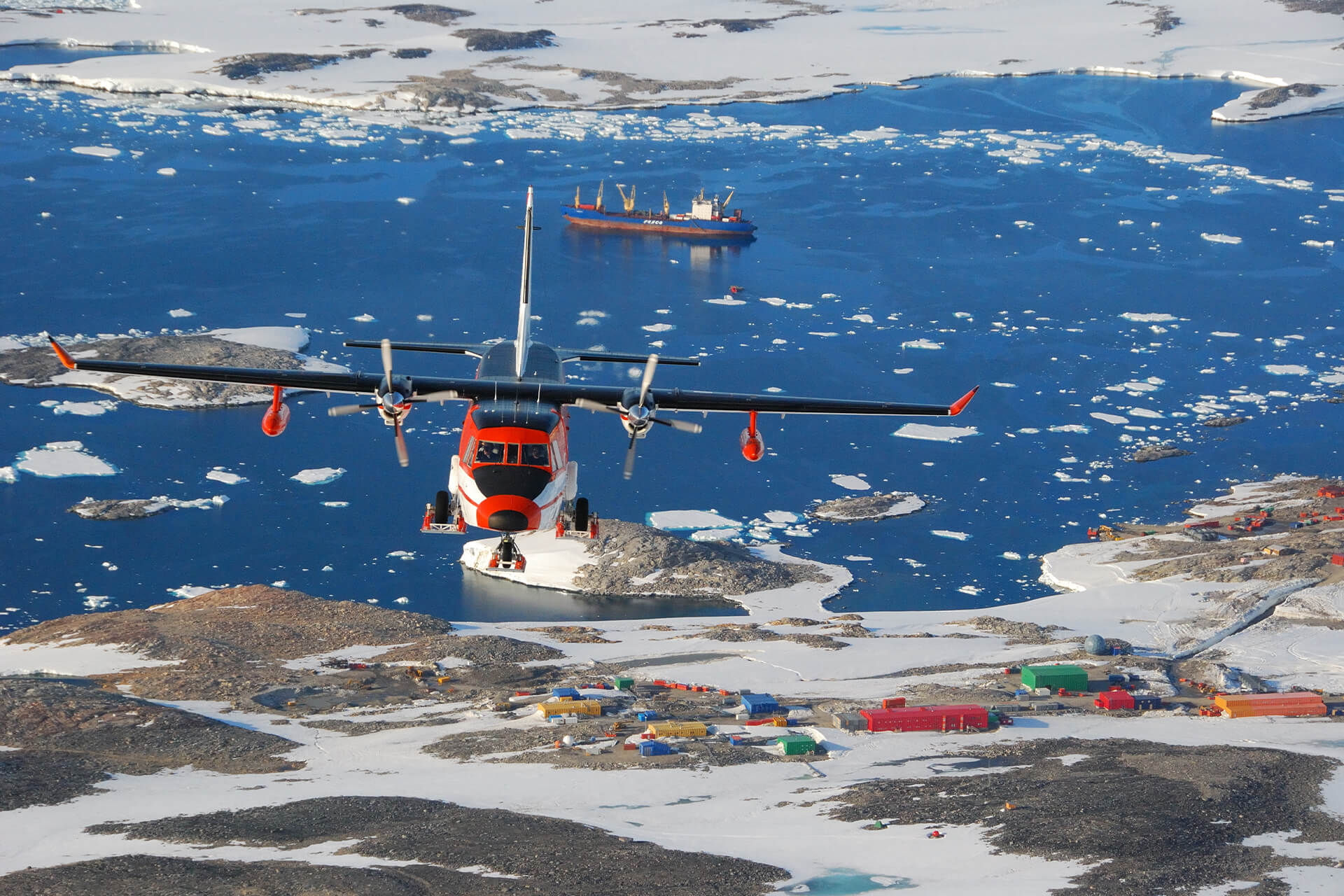
Once in Antarctica, scientists may still need to travel great distances to reach their research sites. Stations, field camps and field sites are scattered across the frozen continent, and journeys between them can take days or even weeks across glaciers, vast ice sheets, exposed coastlines and polar seas.
Transport in Antarctica depends on distance, terrain, season, and what needs to be carried.
Field teams rely on specialised vehicles and aircraft built for extreme cold and remote conditions. The transport method used depends on the environment, from short coastal trips near stations to long inland traverses across the ice.
Weather, visibility and surface conditions can shift quickly, and travel plans often need to adapt at short notice.
In Antarctica, the right transport depends on distance, terrain, weather, and how much equipment needs to be moved.
Near stations, short trips may be made using over-snow vehicles or small boats. Helicopters are used where access is difficult and landing space is limited, though they are especially sensitive to weather conditions.
Fixed-wing aircraft are often used to move people and equipment over long distances, particularly where overland travel would be slow or impractical. For larger scientific campaigns, tracked traverses may be used to haul heavy equipment and fuel slowly across the ice sheet over hundreds of kilometres.
Much of Antarctica is travelled slowly, over ice and snow.
Some are used for short trips near stations, while others support larger operations, hauling heavy loads over hundreds of kilometres. The vehicle selected depends on the distance, duration, number of people, and what needs to be carried.
Route complexity is a critical consideration, as overland travel involves navigating surface hazards such as changing ice thickness, fractures, crevasses, and unstable sea ice.
Fixed-wing aircraft and helicopters play an essential role in moving people and equipment across Antarctica.
Helicopters are used for more precise access where no runway is available and a larger aircraft cannot land, including rocky coastal sites, small islands, ship-based operations and confined field locations.
Each is suited to a different task. Fixed-wing aircraft are generally better for covering long distances and moving larger cargo loads, while helicopters are more flexible at the destination but have shorter range, lower payload and greater sensitivity to weather.
As sea ice retreats in summer, coastal routes begin to open.
Small vessels are often used to reach coastal research sites and move between ships, stations and nearby field locations. Rigid inflatable boats, workboats and kayaks can provide access to places that are difficult to reach overland, including rocky shores, shallow inshore waters and other coastal areas where larger vehicles or aircraft may be impractical.
These smaller craft are often used for short-range travel, wildlife surveys, deploying instruments and accessing landing sites close to the water. Their use depends on local sea and ice conditions, which dictate when and where coastal travel is possible.
CONTINUE YOUR PATH
After travelling across ice, sea or snow — often by combining several modes of transport — teams arrive at field camp.
From here, the journey shifts into the next stage of the expedition, as camps are established and the research begins…