GEOLOGY

The Geology of Hidden Antarctica

Beneath Antarctica’s ice shelves and the waters of the Southern Ocean lies a hidden geological landscape of broad shelves, deep basins and submerged mountain ranges. Shaped by tectonic forces, powerful ice sheets and ocean processes over millions of years, this buried terrain helps explain how Antarctica formed and how it influences the surrounding ocean today.

Over millions of years, Antarctica was pulled apart from other continents and buried beneath vast ice sheets. As glaciers advanced across the continent, they eroded rock, carved deep valleys, and transported immense quantities of sediment into the ocean.


As the ice advanced and retreated across the shelf during past glacial periods, it cut deep submarine troughs and basins into the seabed. Some stretch for hundreds of kilometres and are still clearly visible in modern bathymetric maps.

Today, these banks, ridges and troughs continue to influence ocean circulation, sediment distribution, and the habitats available for marine life across the shelf.

A Continent That Drifted South

Antarctica has not always been frozen at the bottom of the world.

More than 180 million years ago, Antarctica formed part of the supercontinent Gondwana, alongside South America, Africa, Australia and India.

Rocks and fossils preserve signs of a much warmer past, when forests once grew on parts of the continent long before it froze over.

Over tens of millions of years, tectonic forces gradually pulled these continents apart and opened new ocean basins, separating Antarctica from its former neighbours. The final separation from South America was a major tectonic turning point. The powerful Antarctic Circumpolar Current developed and now flows around Antarctica, isolating the continent from warmer waters and influencing global climate.

As Antarctica drifted south and became increasingly isolated, these changes in ocean circulation helped drive the growth of the vast ice sheets that define the continent today. Much of the landscape shaped by this history now lies hidden beneath the ice sheet and the surrounding Southern Ocean.

Ice Sheets that Shaped the Seafloor

The continental shelf surrounding Antarctica is unlike most others in the world.

While many continental shelves are relatively shallow, the Antarctic shelf is broad and unusually deep, lying 400–700 metres below the ocean surface in many places. Over millions of years, the immense weight of the ice sheet pressed the crust downwards, while advancing ice carved and eroded the seafloor.

As the ice advanced and retreated across the shelf during past glacial periods, it cut deep submarine troughs and basins into the seabed. Some stretch for hundreds of kilometres and are still clearly visible in modern bathymetric maps.

Today, these banks, ridges and troughs continue to influence ocean circulation, sediment distribution, and the habitats available for marine life across the shelf.

Footprints of Retreating Ice

As ice withdrew from the Antarctic shelf, it left a scattered trail across the seafloor.

When grounded ice paused during retreat, sediment built up at the point where the ice began to float, forming underwater ridges known as grounding-line wedges. These ridges record places where the ice margin remained stable for a time before retreating further.

Farther out, drifting icebergs scraped the seabed as they moved, carving long grooves known as plough marks. These marks show where large icebergs once dragged across the seafloor after breaking away from the ice sheet.

Rocks carried out to sea frozen in glacial ice were released onto the seafloor as the ice melted, leaving isolated dropstones in soft and otherwise featureless sediments. Some may have travelled hundreds of kilometres seaward from their original source.

Together, these features offer glimpses of Antarctica’s shifting glacial past.

Sediment on the Move

Sediment eroded from Antarctica does not stay at the coast. Carried to sea by ice, it is deposited across the continental shelf and then gradually reworked by currents, gravity and underwater flows.

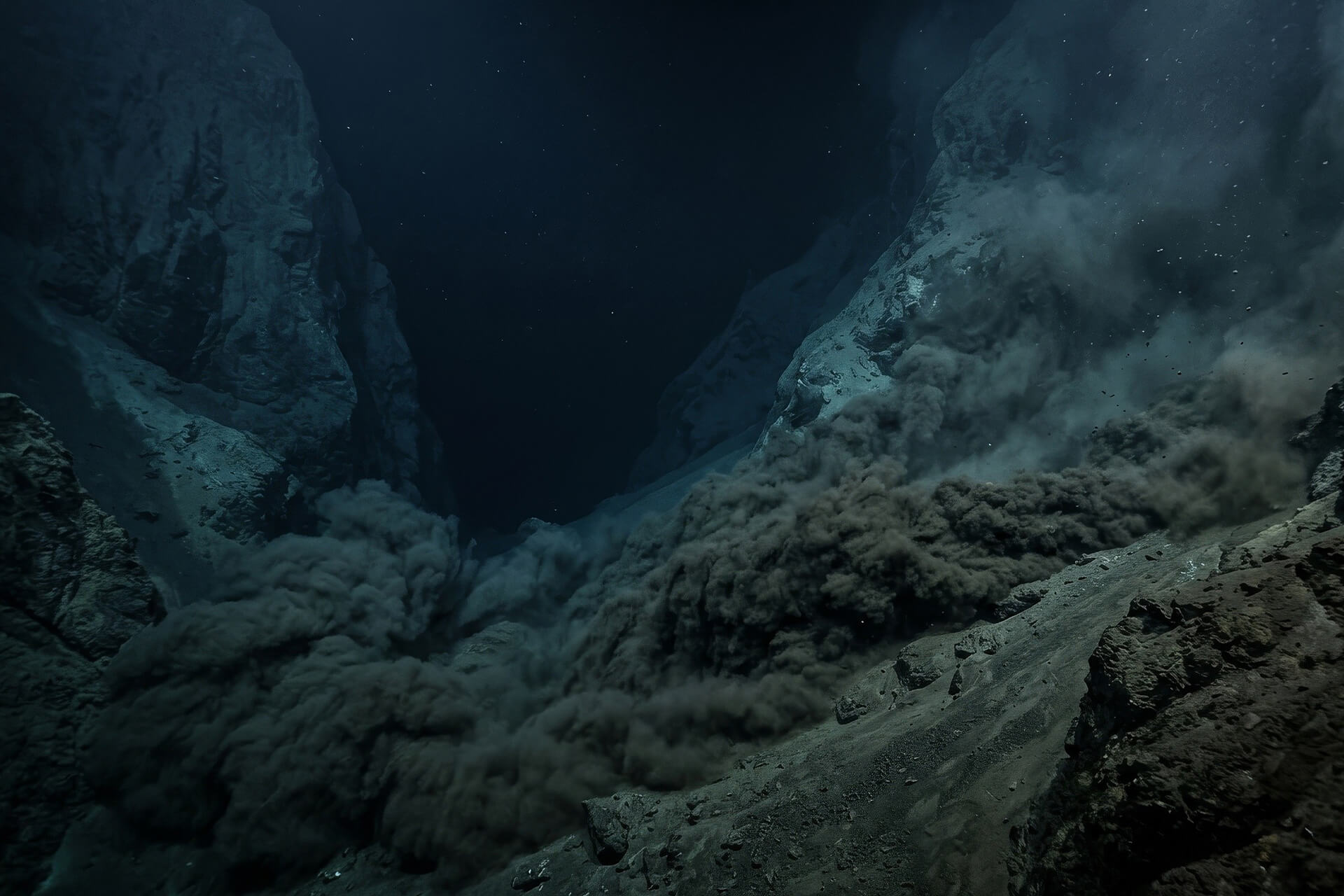
 Some material moves slowly across the seabed, while other sediment is swept rapidly downslope in dense turbidity currents. Over longer periods, persistent ocean currents build broad mounds and ridges known as sediment drifts, leaving visible signs of the direction and strength of deep-water flow.

From here, Antarctic sediment continues its movement from the shelf into deeper waters, linking the continent to the wider Southern Ocean.

Into the Abyss

Beyond the edge of the Antarctic continental shelf, the seafloor drops sharply into the deep Southern Ocean.

This steep descent forms the continental slope, where submarine canyons cut into the seabed and help funnel sediment into deeper waters. From here, material eroded from the continent begins its final journey into the deep ocean, where it spreads across the Southern Ocean to form vast sedimentary landscapes.

Beyond the slope lie the deep ocean basins and abyssal plains – some of the most remote and least explored environments on Earth. In these deep regions, sediment accumulates over long periods of time, building layered archives that help scientists reconstruct past ice-sheet behaviour, ocean circulation and climate change.

How Scientists Reveal the Hidden Landscape

Until recently, the shape of the Antarctic seafloor was largely unknown. Modern technologies now allow scientists to map the ocean floor in remarkable detail.

Scientists use ship-based surveys, geophysical measurements and sediment records to reveal the landscape beneath Antarctica’s ice and surrounding seas. Multibeam sonar maps the seafloor, seismic surveys image layers buried beneath it, and sediment cores preserve records of past ice, ocean and climate change. In places where direct measurements are sparse, scientists combine multiple geophysical datasets to help map the bed below the ice and ocean.

Together, these observations show how Antarctica’s ice sheets and surrounding seas have changed through time.

Much of the seafloor has yet to be mapped, and new discoveries will continue as exploration technologies improve.

CHOOSE YOUR PATH

Dive into the deep

Travel from the underside of Antarctic ice shelves to the abyssal plains thousands of metres below.

Explore hidden biology

Explore the unique ecosystems that inhabit the Antarctic ocean and seafloor.

Back to base

Head back to base and choose another path across the frozen continent.